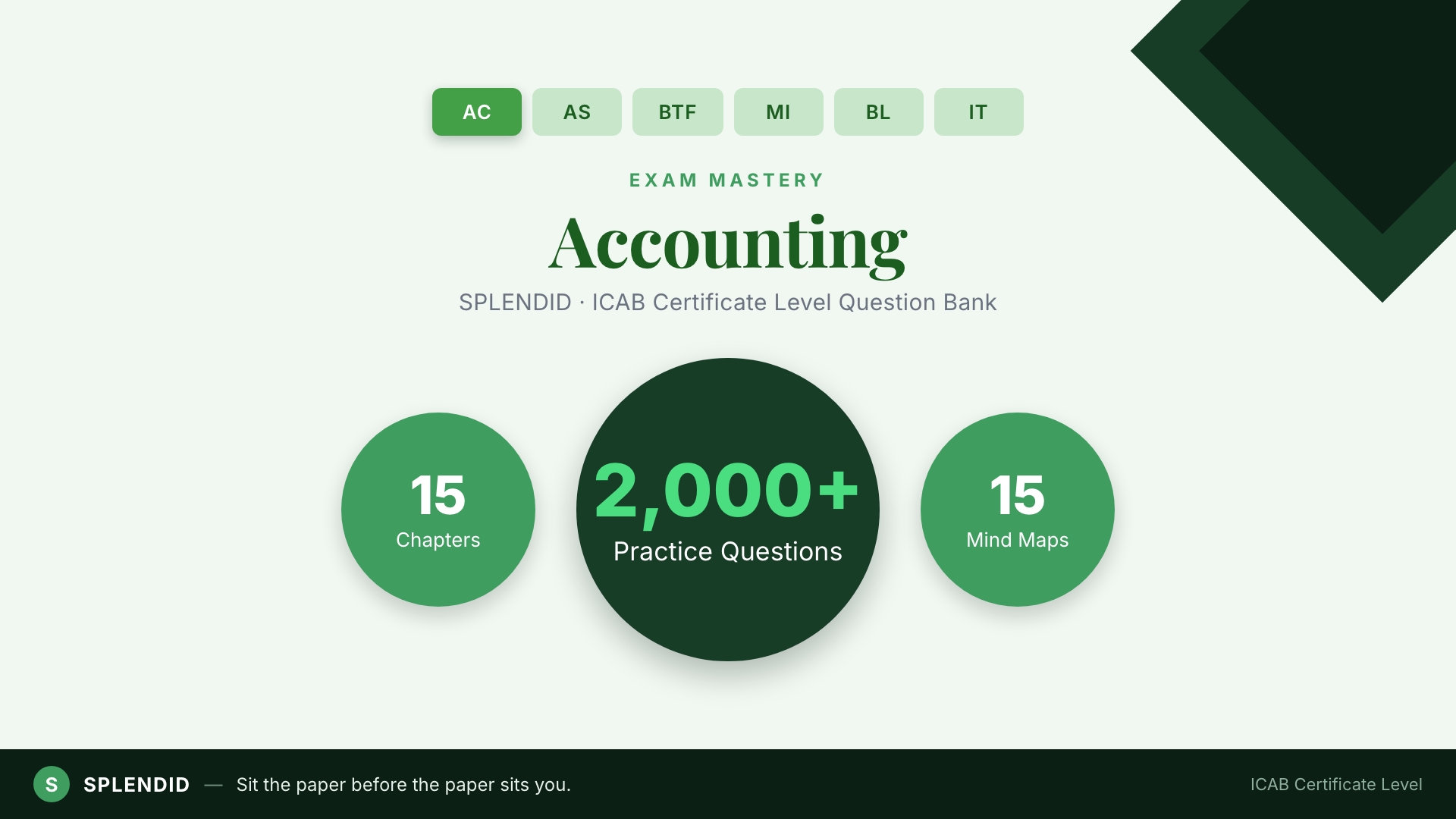
Accounting Exam Mastery
Categories: Certificate Level
Wishlist Share

About Course

Accounting is the largest module in the Certificate Level bank and the most
heavily calculated. It takes you from the accounting equation and double entry
through to a full set of company financial statements under IFRS, a statement of
cash flows, and the partnership and public-sector variants that candidates
routinely lose marks on.

The bank is weighted the way the syllabus is, with preparing financial
statements carrying the most, then adjustments to records and statements,
maintaining financial records, accounting concepts and ethics, and public
financial management.

This is a working module, not a reading one. Most of it asks you to calculate a
figure and type it in, and it includes full twenty-mark pro-forma statements
marked box by box. You practise producing the numbers, because that is what the
paper asks for.

Show More

What Will You Learn?

  • Post any transaction correctly through the ledgers using double entry
  • Build a trial balance and find the errors that stop it balancing
  • Apply cost of sales and inventory valuation, including net realisable value
  • Account for irrecoverable debts and the allowance for receivables
  • Apply accruals and prepayments to arrive at the right profit figure
  • Calculate depreciation and impairment on non-current assets, and account for disposals
  • Prepare a set of company financial statements under IFRS
  • Prepare a statement of cash flows from opening and closing positions
  • Prepare sole trader and partnership financial statements, including appropriations
  • Apply the accounting concepts, ethical principles and sustainability requirements the syllabus names
  • Answer public financial management questions to Certificate Level depth
  • Type a calculated answer to the tolerance the real paper accepts

Course Content

Chapter 1: Introduction to accounting

  • Mindmap
  • Practice Mock
  • Result

Chapter 2: The accounting equation

Chapter 3: Recording financial transactions

Chapter 4: Ledger accounting and double entry

Chapter 5: Preparing basic financial statements

Chapter 6: Errors and corrections

Chapter 7: Cost of sales and inventories

Chapter 8: Irrecoverable debts and the allowance for receivables

Chapter 9: Accruals and prepayments

Chapter 10: Non-current assets, depreciation and impairment

Chapter 11: Company financial statements

Chapter 12: Company financial statements under IFRS

Chapter 13: Statement of cash flows

Chapter 15: Sole trader and partnership financial statements

Chapter 16: Public financial management

Comprehensive Exam

error: